As collectors and players of both the Pokemon and Magic: The Gathering trading card games (TCGs) since the late 1990s, we’ve seen all kinds of cards here at Collectiwiz, ranging in value from a few cents to tens or hundreds of thousands of dollars.
And we’ve received all sorts of questions about topics like appraisal of single cards or huge collections, the most valuable Pokemon or Magic cards from the early years, metal Pokemon cards, and most commonly, whether Pokemon or Magic: The Gathering cards are real (aka authentic) or fake (aka counterfeit).
While there are some internet resources and Reddit boards that cover identifying real vs. fake cards, we’ve found that this information is somewhat fragmented and can be hard to understand.
So, we decided to write this Knowledgebase article with an easy-to-understand, step-by-step guide to spotting fake cards with pictures of actual Pokemon and Magic: The Gathering cards, covering:
The difference between fake and real cards for both of these TCGs
Specific characteristics of real and fake cards to look for including up-close high-resolution photos of these features
Inexpensive tools like jeweler loupes that you can buy to help you discern real cards from fake cards
Where to purchase Pokemon, Magic, and other TCG cards to make sure you’re buying real single cards
If you’ve determined that a card is real and want to know how professional grading can increase the value of cards and other collectibles, make sure to check out our other recent article in our Knowledgebase: “To Grade or Not to Grade?: When Should You Send Pokemon, Magic: The Gathering or Sports Cards to Be Graded by PSA, BGS, or CGC?“.
Difference between Fake and Real Cards in Trading Card Games (TCGs): Pokemon and Magic: The Gathering
When comparing real and fake Pokemon or Magic: The Gathering, there are a few “clear giveaways“ that a card is fake before you need to dive into more complex techniques (which we’ll cover in the next two sections below).
First, if the card contains spelling errors or very weird font not usually seen in either trading card game, the card is almost guaranteed to be fake. While some very early Pokemon and Magic: The Gathering cards did feature prominent spelling mistakes, vintage and modern cards with these mistakes are pretty much always counterfeit.
Second, the type of card stock that the card is printed on can be another giveaway. If the card feels super thin and extensive light shines through when holding the card up to a bright light, you can also guarantee that the card is fake.
Real Pokemon cards are printed on special multi-layer blue core or black core card stock that is between 300 and 300 Grams Per Square Meter (GSM) in weight, whereas Magic: The Gathering cards are printed on a custom-made “Corona“ blue core card stock that is 320 GSM with graphite or plastic laminate to make the cards more opaque (aka not see-through).
Third, look at the edges and corners for very rough cuts or visible separation of the layers of the card stock. While real Pokemon or Magic cards can have poorly cut corners or tiny pieces of card stock hanging on to the edges, fake cards can be discerned by very poor cutting or inconsistent corner rounding on one or more corners.
Now that we’ve covered three features in common for fake cards in both Pokemon and Magic: The Gathering, let’s jump into specific features of fake vs. real Pokemon cards and then we’ll cover unique characteristics of fake vs. real Magic cards.

Real Pokemon and Magic: The Gathering cards are printed on special, mostly opaque card stock with vibrant colors and well-cut rounded corners.
Specific Characteristics of Real and Fake Pokemon Cards: Comparison of Features in Authentic and Counterfeit Cards
Beyond the features that fake Pokemon and Magic cards share, there are also specific characteristics that are unique to Pokemon cards to help you detect fake cards.
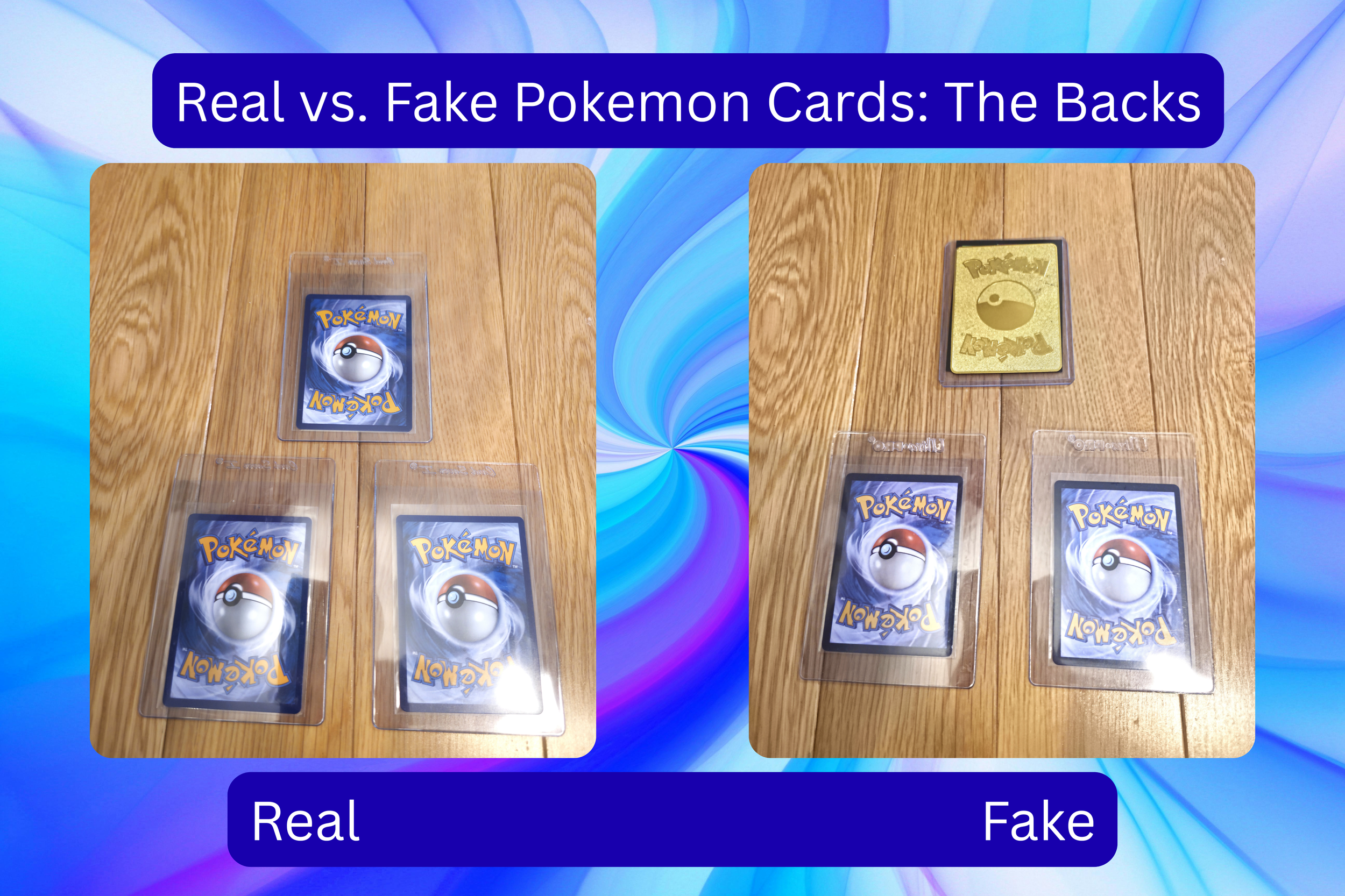
Let’s start with the back and the “blue test”. One dead giveaway of a fake card is a uniform blue color underneath the “O“ and “N“ on the top right of the card.
Real Pokemon cards have a unique pattern with splashes of blue that almost look like bush strokes moving to the right side. See the image below, which compares real cards on the left side with this unique pattern and a fake cards with a solid blue color.
Fake cards also have backs that appear dull or faded, whereas real cards have vibrant blue, red and yellow colors, with white swirls surrounding the Poke Ball in the middle.
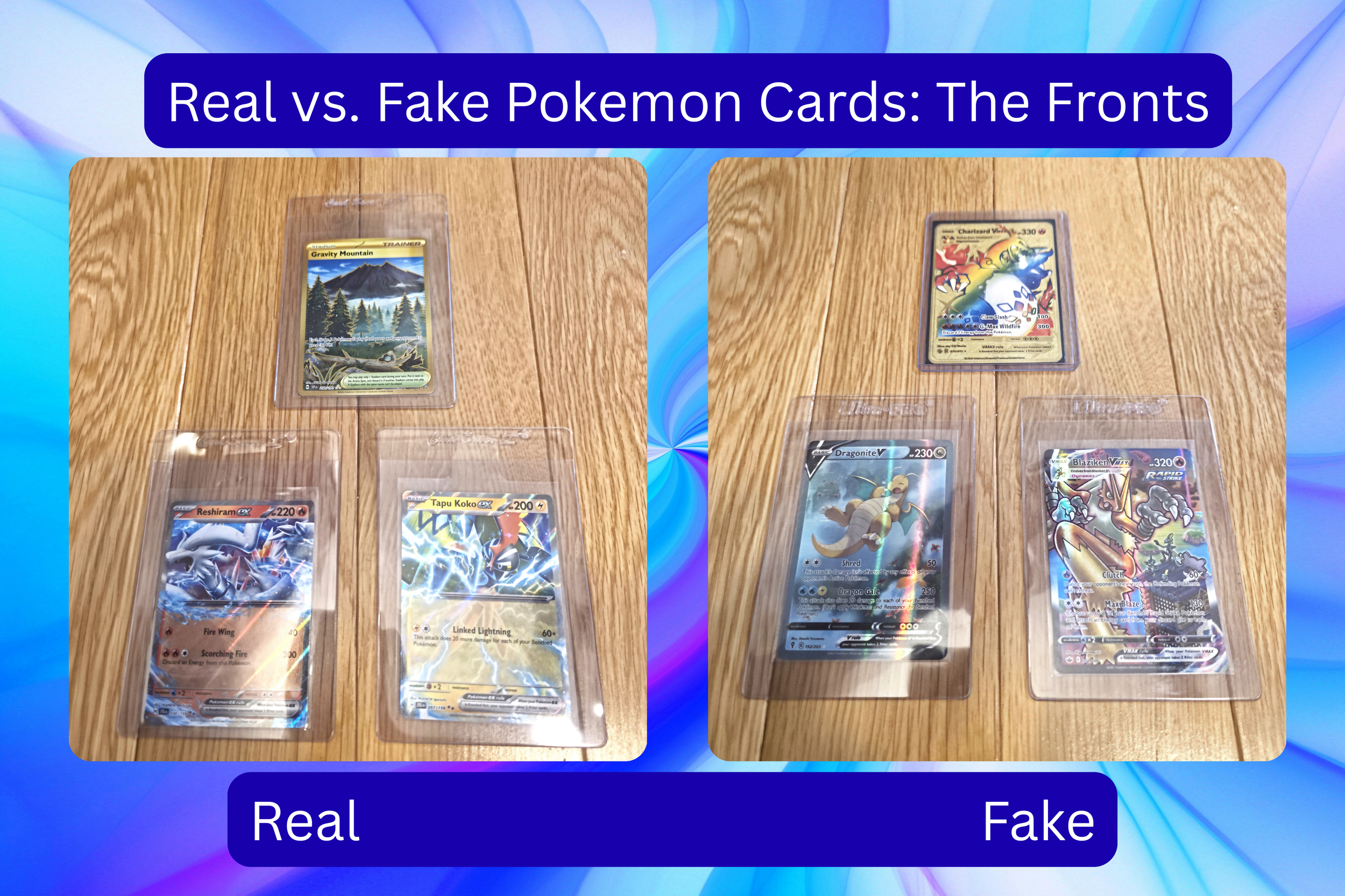
Turning to the front, beyond spelling errors and other clear signs of counterfeit cards we covered above, do the “font test“: the font on Pokemon cards is unique and is not a widely-available serif or sans serif font.
When in doubt, look up the specific card online or go to a local card shop to see a copy of the card you think might be fake and compare the font style, which will usually reveal whether a card is fake or real.
Finally, because almost all valuable cards have foiling on either the image or the entire card, and this foiling or “shiny“ finish pattern is distinctive and very difficult to duplicate accurately.
With modern cards, you can do the “texture test“: foil rares from recent sets (from the past 5 to 7 years) have a sort of “texture“ that indicates a real card, whereas fake cards often clearly do not have this same texture and appear almost smooth.
Once again, a good way to identify real foil cards is to find a reputable seller (like us at Collectiwiz, maybe? ;) ) or a well-known YouTube streamer, and see what the foiling looks like, ideally in person.
Taking into account both these unique features of Pokemon cards and the other characteristics described above for both Pokemon and Magic cards will make it very unlikely that you’ll accidentally buy or trade for fake cards in the future.
If you have some old Pokemon cards stashed away and/or if you’re interested in the most valuable Pokemon cards from the late 1990s and early 2000s, make sure to check out another recent article in our Knowledgebase entitled: “The Most Valuable Pokemon Cards from the Late 1990s and Early 2000s: Pikachu, Charizard, Lugia and More“.
Specific Characteristics of Real and Fake Magic: The Gathering Cards: Comparison of Features in Authentic and Counterfeit Cards
Just like Pokemon cards, Magic: The Gathering cards also have distinctive features on the back and front to help you detect fakes and ensure you’re buying real cards.
By far, the most popular way to identify fake Magic cards is the “green dot test“, which involves looking very closely at the green dot on the back of the card.
To really do this test correctly, you need a jewelers loupe, electronic microscope — or in a pinch — a magnifying glass (we link to high-quality options for these items in the next section).
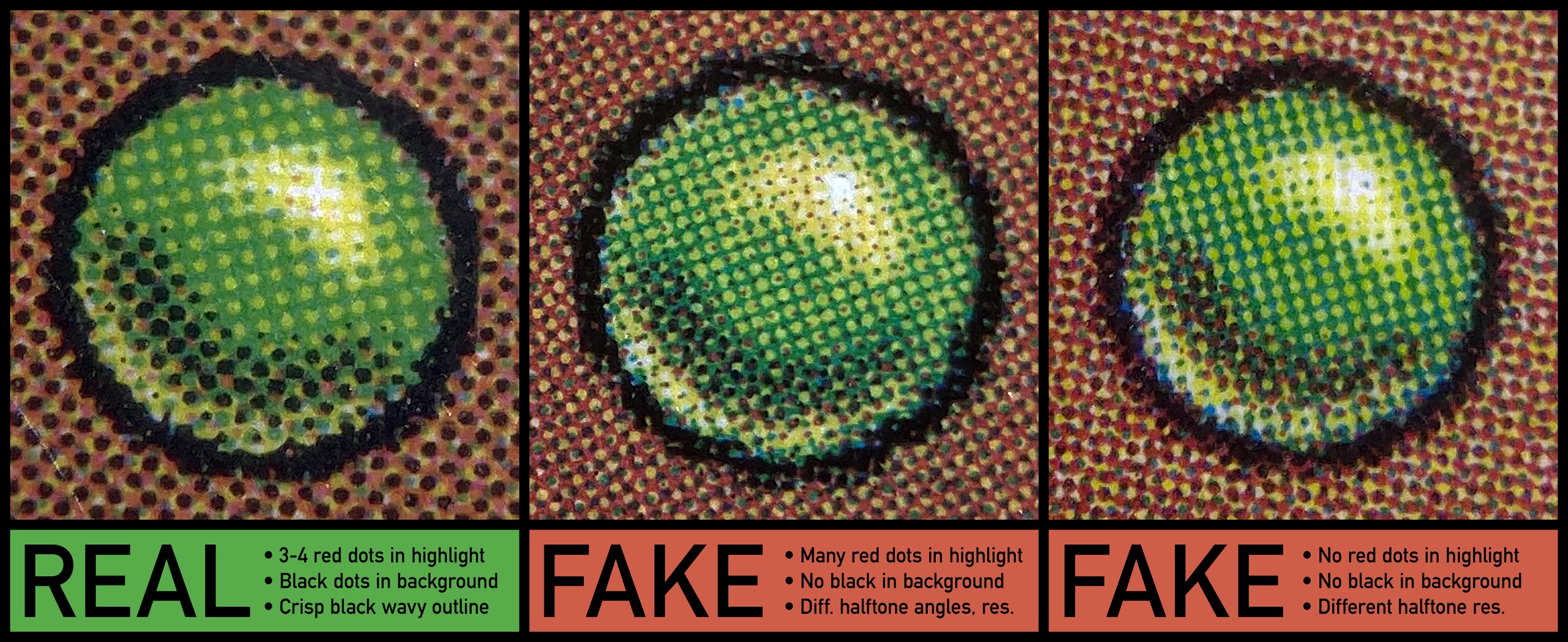
The “green dot” test is the best way to tell a real Magic: The Gathering card from a fake one. Image from user u/loglow_ on the r/magicTCG subreddit.
Once you have an up-close view or photograph of the green dot (see the photo here comparing the green dot on a fake card and a real card), look closely for 3 to 4 red dots inside of the white highlight in the top right of the green dot.
Real cards have only 3 or 4 of these red dots inside the white highlight, while fake cards either have lots more red dots or no red dots in this spot at all.
Next, look at the black surrounding the green dot and it should be dark and uniform, with additional mostly uniform black dots in rows and columns over the brown background outside of the dots.
The other most important test is the “T test”, which involves looking for a jagged, “saw-like“ pattern at the bottom of the capital “T“ in the text that says “The Gathering” on the back of the card.
Fake cards have either a smooth pattern in this area, or a solid line, making it relatively easy to detect under magnification.
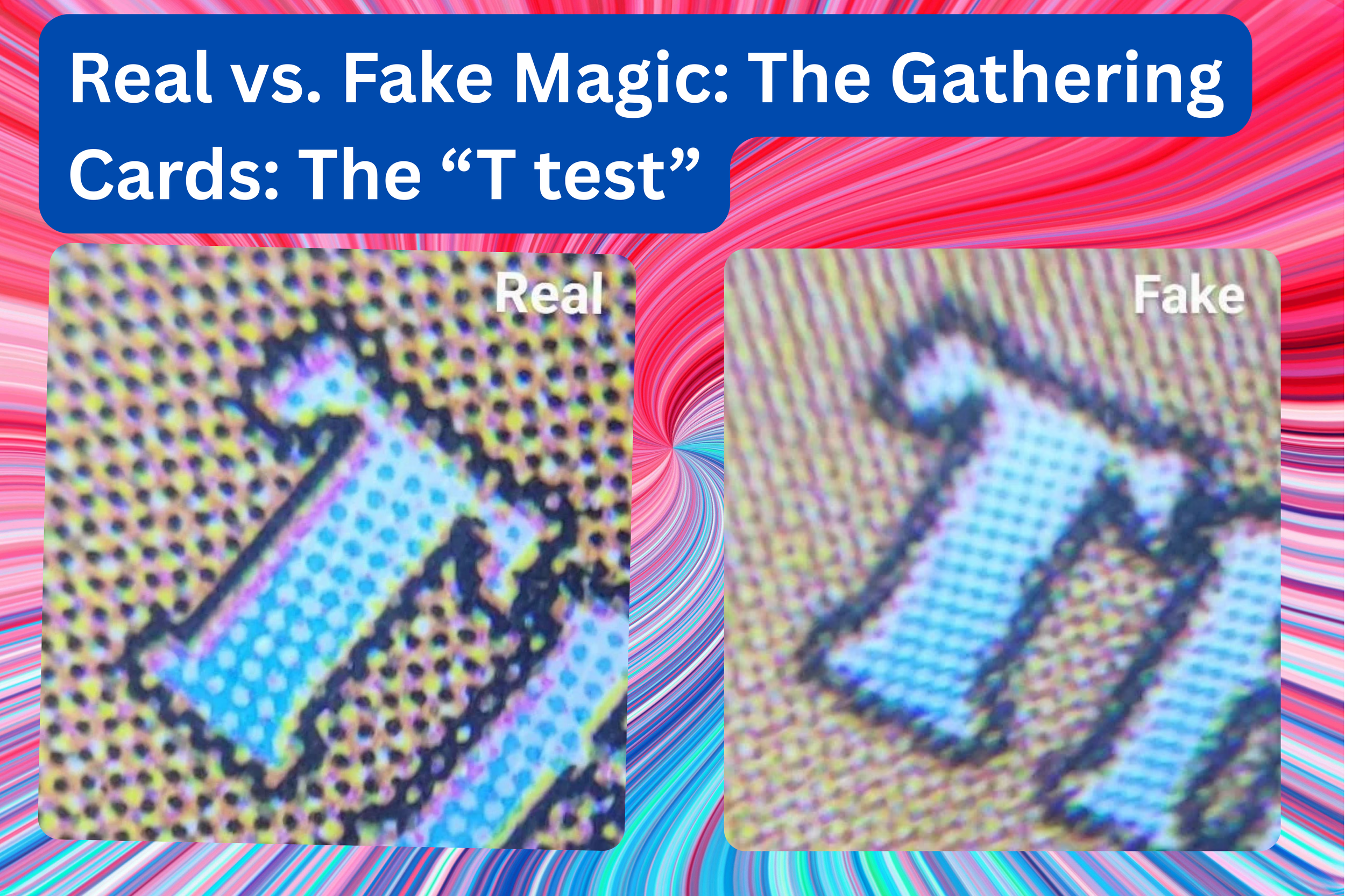
The “T Test“ is a great second test for checking in a Magic: The Gathering card is real or fake. Images from user u/GhostCheese from r/Upload2Imgur subreddit.
In terms of the front of Magic cards, two features are important to look at closely.
For modern cards, rare and mythic rare cards have a shiny foil symbol at the bottom that is distinctive, and which is difficult to fake.
Look at a few real cards in a local card shop and you can start to discern this foil symbol at the bottom and recognize its absence in fake cards.
Lastly, there is the light test, which works in most cases but should only be used with these other tests.
The light test involves shining a bright light like a flashlight through the card, which should show a grayish-blue color that is consistent throughout the card, whereas fake cards usually show a pale or white color, or allow too much light through the card.
Next, let’s take a look at a few mostly inexpensive tools to help you best identify fake Pokemon or Magic cards.
If you’re interested in collectibles market trends more generally or for Magic: The Gathering specifically, make sure to check out this recent article in our Knowledgebase: “Top 5 Collectibles Market Trends to Look for in 2025, 2026, & Beyond for Pokémon, Magic: The Gathering, Yu Gi Oh, & More“.
Inexpensive Tools to Help You Discern Real TCG Cards from Fake TCG Cards
Luckily, you don’t have to do all the checking for fakes with your bare hands and eyes!
There are several super helpful tools to help you in your quest for real cards (some of these may be affiliate links, which help pay for our hosting costs):
Jeweler’s loupe with built-in LED light: An excellent and inexpensive tool to help you look closely at the back and front of trading cards.
Traditional compound microscope: A more sophisticated tool to look at trading cards capable of higher levels of magnification.
Digital microscope with USB and SD card: An even more advanced tool for magnification, with the ability to save magnified images via memory card or on a computer for sharing.
High-powered magnifying glass with 6-color mode LED: A basic tool with built-in light that is portable and helpful for many purposes beyond detecting fake cards.
Philips High-Lumen LED flashlight: An awesome device for determining the opacity of cards, as well as other collectibles like paper money and stamps.
These tools are a great way to make sure you’re buying and collecting only real cards, and most of them will fit in your pocket to take to collectibles conventions, local card stores, or card shows.

Where to Buy Pokemon, Magic, and Other TCG Cards to Make Sure You’re Getting Real Cards
Now that we’ve covered how to tell real from fake cards and the best tools to help you detect counterfeit cards, let’s do a quick rundown of the best places to buy sealed & real Pokemon or Magic: The Gathering cards.
Beyond local card stores or reputable online collectibles stores (maybe us at Collectiwiz ;) ), there are several large chain stores that stock the latest sets for Pokemon and Magic.
And the best part is, these stores actually sell sealed packs and boxes at retail price.
Note: In the past, we would have included GameStop on this list, but due to their greatly inflated prices starting in late 2025, we no longer recommend purchasing cards from them.
Here’s a list of these stores, along with a few tips about each:
Best Buy: Extensive selection of cards online and in store, with limits to allow real collectors and players to buy cards.
Costco: Member-only warehouse store that sometimes gets amazing deals for sealed trading card boxes and packs.
Target: Large big box store that stocks new Pokemon and Magic sets on release day, with occasional restocks online and in-store.
Walmart: Similar to Target, but also with the benefit of “Walmart Wednesday“ online drops on Wednesday evenings.
Micro Center: Smaller electronics retailer that also sells Pokemon and Magic cards, but only in store and with strict limits.
Ace Hardware: Hardware store that surprisingly sells Pokemon cards in some locations.
eBay (make sure to compare prices): Huge internet-only marketplace with individual sellers who sell singles and sealed boxes and packs, sometimes above MSRP.
Amazon (make sure to compare prices): Also a massive marketplace with individual sellers selling above MSRP, so look for “Shipped & Sold By Amazon“ to get the best price.
While there are of course many other websites, these are the eight that we recommend, and we’re happy to hear from you about other brick-and-mortar or online retailers who sell Pokemon or Magic: The Gathering cards at fair prices!
Just send us an email at info@collectiwiz.com or fill our our Contact Form, and we look forward to hearing from you! You can also send us a message via our Social Media accounts, on Instagram, Facebook or LinkedIn!
The Bottom Line: Fake vs. Real Trading Cards in 2026, 2027 and Beyond
So there you have it! After reading our detailed guide above to spotting fake and real Pokemon and Magic: The Gathering cards, you’re well on your way to becoming an expert and will greatly reduce the chance of buying counterfeit cards by accident.
We appreciate you checking out this Knowledgebase article and we’re interested to hear your thoughts!
Have you ever came across fake cards or bought fake cards yourself? Do you have any other tips for spotting fake cards?
Let us know in the comments on this article, on our Instagram, Facebook page, or via email or DM!
And while you’re here, make sure to check out our Sealed Packs & Boxes page, plus if you’re into Pokemon card collecting and playing, you won’t want to miss our super popular guide to all Poke Ball Tin and Mini-Tin Codes, which shows exactly which packs you’ll get in these sealed metal tins based on the code on the bottom.